Sourcing high-volume stainless steel components often leads to overseas shipping delays or high domestic machining costs. Securing a reliable supply chain for these dense alloys is a frustrating challenge for any buyer.
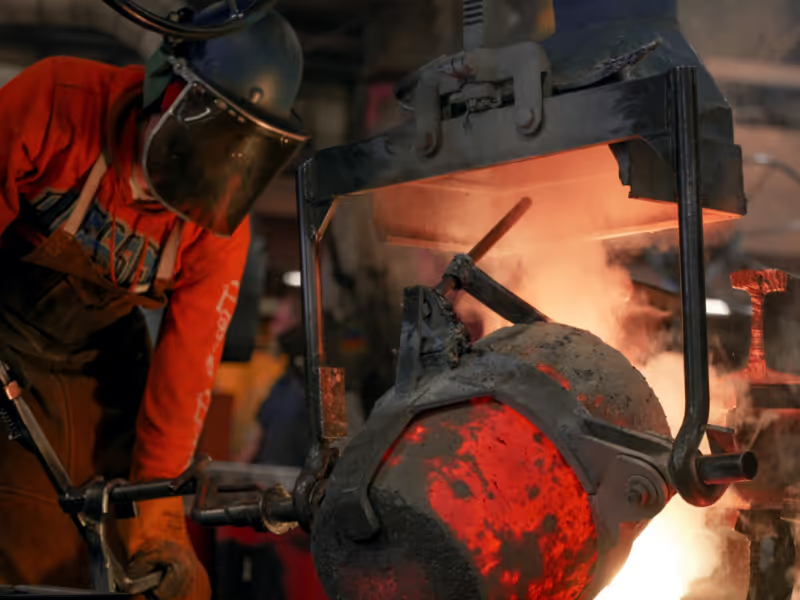
At Lincoln Foundry, our highly skilled technicians pour high-grade 304 and 316 stainless steel castings from our Erie, PA, facility. We take on the hard, dirty work of shaping these dense alloys so you receive a corrosion-resistant component made with honest American grit.
Read on to learn more about how our ISO-compliant foundry delivers the exact physical strength your parts require.
Get a Quote for Stainless Steel Casting »
Shaping dense alloys requires a manufacturing approach that balances structural integrity with cost efficiency. Choosing to cast these components provides several distinct advantages for your production line:
Reduced Material Waste: Casting achieves a near-net shape right out of the mold. This precision drastically reduces the amount of expensive raw material you lose to scrap.
Complex Internal Geometries: The process easily forms intricate internal cavities and thin walls. You gain the freedom to design complex components that a CNC machine cannot physically reach.
Part Consolidation: Pouring a single solid piece eliminates the need to weld multiple parts. This consolidation removes weak joints and cuts down your manual assembly time.
High-Volume Repeatability: Hard tooling ensures your exact dimensions are locked in across large production runs. You bypass the physical variations of manual fabrication and scale your orders without mismatched parts.
Zero Tooling Wear: Liquid metal bypasses the mechanical resistance that normally destroys expensive cutting tools. You avoid the heavy replacement costs associated with milling dense alloys.
At Lincoln Foundry, we're a Pennsylvania-based stainless steel casting company that specializes in 304/316 grades. Pouring these specific alloys in our domestic facility gives you direct control over your supply chain. You avoid the shipping delays and poor metal chemistry often found with overseas suppliers.
We pour the two most common austenitic grades to match the exact corrosion resistance your application requires:
Lincoln Foundry pours 304 stainless steel (cast equivalent CF8) for components that need standard protection against rust and oxidation. CF8 conforms to ASTM A743 for general corrosion-resistant castings and to ASTM A351 for pressure-containing parts. We certify the chemistry to the standard your application demands, so you receive a part that withstands daily washdowns and sterilization cycles in food processing and medical equipment.
We cast 316 stainless steel (cast equivalent CF8M) for parts that operate in severe chemical or marine environments. CF8M conforms to ASTM A744 for severe service castings and to ASTM A351 for pressure-containing components. The added molybdenum resists pitting from saltwater and industrial acids. Your components stay intact in these corrosive settings.
We pour custom parts for machinery that endures constant moisture and heavy wear. Matching the right alloy to your specific field keeps your equipment running and prevents rust.
Review the chart below to see how these two grades compare across different industries:
Pouring stainless steel requires a disciplined approach to metallurgy and floor management. We verify the chemical and physical integrity of your components before they ever leave our facility. Every pour is documented and linked directly back to our foundrymen, so you receive a fully traceable, ISO and ANSI-compliant part.
Our process starts by melting certified raw ingots backed by certificates of analysis. Lincoln Foundry technicians then confirm the metal's chemical composition using our in-house SpectroLab, so you receive the corrosion resistance you ordered. Finally, we use a bar puller to verify the heat's tensile strength, ensuring the final component withstands your physical loads.
Q: Why choose Lincoln Foundry for stainless steel castings?
A: Sourcing your parts from an expert domestic facility gives you access to complete end-to-end manufacturing. We handle the pouring, machining, and final finishing under one roof so you receive a completed component ready for immediate assembly.
Q: What size stainless steel parts do you pour?
A: Our foundry floor accommodates custom metal components weighing anywhere from a fraction of an ounce up to one hundred pounds. You can request poured pieces up to three feet in length to fit your specific industrial machinery.
Q: Do you provide secondary finishing for raw castings?
A: Every poured part includes standard shot blasting and grinding to remove excess material from the sand mold. You can also request additional machining and powder coating to achieve the exact surface texture your final application requires.
Stainless steel casting provides a highly cost-effective way to produce complex metal shapes. This process gives you a corrosion-resistant part that holds up under heavy daily use.
At Lincoln Foundry, we pour high-quality alloys right here in Pennsylvania to keep your assembly lines moving. You gain a dedicated domestic supplier who takes pride in getting the dirty work done right.
Christopher Campbell
Experienced leader at Lincoln Foundry with 15+ years spanning shop floor to ownership. Combines hands-on molding expertise with executive oversight, RFQ quoting, and metallurgical testing to deliver high-quality non-ferrous castings with exceptional consistency and low defect rates.
Key Differentiators